Saturday, May 10, 2025

The Return Of The Thin White Duke

 Bowie...

     Here are we, one magical movement
                                                         From Kether to Malkuth
                                                         There are you drive like a demon 
                                                         From station to station

(YouTube Video)
_______________

  In walked luck and you looked in time
                                                      Never look back, walk tall, act fine

(YouTube Video)
_______________

Encore....

 Maybe if I pray every, each night I sit there pleading
                                         "Send back my dream test baby, she's my main feature"
                                          My TVC 15, yeah, he just stares back unblinking

(YouTube Video)

... some albums should include mandatory Sennheiser headphones 

Thursday, May 1, 2025

Old Dad Tales Of Bulls*t: Leonard Jones; High Striker; Rock The Hot Car

"The liars punishment is, not in the least that he cannot 
          be believed, but that he cannot believe anyone else" 
                                                        - George Bernard Shaw

Dedicated to a few of those guys we know - lets include all the "one uppers" in there too
_______________

A few past Sundays ago was spent most of the day helpin' two old buddies saw cut a pretty large, uprooted, deadfall oak tree into firewood. Was a bit of a chore. The old oak was at the least 3ft diameter at the caliper; maybe 60ft length. Sectioning the tree by chainsaw was the easy task. Hauling the 14 inch length, quite heavy, cordwood up a bit steep slope over considerable distance turned out to be the big job.

Had worked with "Chuck", on whose property the tree toppled, long ago and for quite a few years, both of us employed by US Steel. Subsequently, did a bit of reminiscing throughout the course of the day. Both our recollections drew a blank, name wise, when it came to recall of one fellow worker in particular. It was one of those instances, too, where the guy's name was right at the tip of the tongue. Try as you might, ya' just can't remember. As well, one of those instances which won't quit nagging' at ya'. 

Got home later that afternoon. Thoughts of the name still lingering at the back of the mind. Turned on the television to check out the weather forecast. The set happened to be tuned to an episode re-broadcat of the old 60's series,  'My Three Sons'. Let it play as the local news and weather was still about a half hour off. Went out to the adjacent kitchen to check the fridge for dinner possibilities.

Half listening to the show, overhear one of the "sons" making a telephone call. The dial-up connects...       
                                            "Could I speak with Leonard Jones, please"...  
What the... that's the name we'd been tryin' to recollect all day... what the f*k is the likelihood of that happenin'... ??!!

Couldn't rewind, but luckily could "On Demand" and fast forward... and damned if that ain't who he asked for!

Haha - probably should have run right down and bought the days lottery ticket.

Better yet - possibly an act of spiritual awakening of higher order. The Great Spirit manifests in mysterious ways. Was Sunday, too. We'll stick with this latter surmise - ain't gettin' any younger.

Jotted down the facts for those who may scoff:
04/13, Pluto TV, ~ 5pm broadcast; 'My Three Sons', Season 3, Episode 8, ~ 23:50 in
_______________

Our US Steel tenure included around seven years working at railroad maintenance and construction. Probably ninety-five percent all hand labor at the time. Hefting and laying track rail, steel plates and cross ties; drivin' rail spikes; snuggin' bolts for splice bars; spreading and tamping gravel ballast. Always outside. Somewhat remote locations. Loved it. Considered it more of a daily physical workout other than a job. Then afterward would hit the gym every evening for at least two hours "pumping iron". Was in pretty good physical condition to say the least.

Driving railroad spikes with a spike maul (aka, spiking hammer) is at first considerably more difficult than it appears. Not only accurately hitting the head of the spike, contact between spike head and hammer has to be square and flat. New guys were always in for at least a month of total harassment by the "gang" before achieving any level of proficiency. Everyone went thru it. Like any other skill, though, ya' continue to persist onward until one day, miraculously and as if overnight, ya' got it. Like ya' been doin' it all your life. Every guy in both gangs (There was an A and a B gang) were eventually master steel driving men. A few would rival 'John Henry'  himself. From pulling track gauge to within a fraction of an inch to driving a spike one handed  in three to five blows. 

Our own hammer proficiency served us extremely well one evening while cruising a local downtown summer street carnival. One of the attractions was the popular "game of skill" wherein' you're handed a heavy wooden mallet with instruction to strike a ground level wooden pad (lever) which in turn drives a steel projectile up a tracked tower, maybe twenty foot maximum height, to strike and ring a large circular "fire bell" to win the game. The tower was incrementally marked off at various heights with expressions such as "wimp", at the lowest level, then progressing thru "weakling", "he-man" and such, on up to "superman" at the bell. Not just a prize-driven objective, the game in-turn "confirmed" your strength as it stood in the world of "real men" depending upon the height you drove the projectile. 

The huckster operating the concession was quite the showman as well. Direct from central casting. Big, heavy muscle man. Bald with broad handlebar moustache. "Ol' Huck" would coerce and cajole passers-by to take the hammer. He'd really lay it on a guy if accompanied by a hot babe. Occasionally he'd grab the mallet himself and damn near drive the bell right off the top of the pole. He also had a 8lb, 36" sledge hammer that he would hold at arms length, then slowly lower to touch the tip of his nose, then reverse the action. The next day we told a buddy, who was no slouch for a display of strength himself, about this guy. He went down that night and almost brained himself attempting the sledge hammer feat. Couldn't clang the bell, either. Close, but not quite Superman. 

Anyway, the "High Striker" was three swings for a buck, as recalled. Hitting the bell all three times would give ya' a choice of some pretty decent prizes. Anything less and ya'd get a cheap blow it-and-roll out noisemaker or plastic horn or such for your effort. All the attempts we'd witnessed were pretty feeble. Guys were barely driving the projectile 3/4 of the way up the tower at best. I'd noticed that each guy was striking the pad at a bad angle - at least forty-five degrees. Stiff legged. And with a wide, wood chopper grip. I was also keepin' a close eye on Huck for any sort of connivance on his part, but couldn't pin him down to anything.

I pay the dollar. Huck is tossing his jibes while alternately all over the gal I'm with. I figured to contact the pad dead-on and square - matched grip, roll the wrists - drop the knees to follow the arc of the swing - just like driving a railroad spike. The motion was by now second nature, anyway. Didn't even have to focus on it. Observed that Huck approached it the same way. Over the head and direct.

(Internet Image)
The secret of the Striker illustrated

Proper technique and ya' don't even have to swing hard - just let the hammer do the work. Physics. Like hitting' a golf ball. You can drive railroad spikes all day and not even get tired. Bad form on the Striker and at best you're shown a weakling

(Internet Image)
An image from a 1935 issue of Popular Mechanics magazine. 

It was a pretty steamy summer night and our gal was dressed in turn for a hot evening. She had Huck's full attention, to say the least. Should he have any trick's up his sleeve, told her to remain standing behind me where Huck would have to move away from the Striker, and distanced from any trickery, to continue planting his paws all over her. He took the bait. If she'd have had a hook in her he'd have been floppin' around like a big ol' snared carp.

Three bucks, three tries. Nine swings, nine clangs of the bell.

Huck was a bit reluctant to let hold of the take. Let the gal pick out the three grand prizes for herself. She was pretty gracious none-the-less. Got our prize later back at her place.

It's good to be Superman.
_______________

Prior to acquiring sufficient time and seniority to bid into the steady daylight track worker position, we put in a 3-4 year stint in the plant's main coke producing facilities. Production is pretty much where all the off-the-street new hires were positioned. 

Coke production involved various duties and functions involved with operation and maintenance of several "Batteries" of coke ovens. A Battery consisted of a unit of maybe sixty interconnected ovens. Each oven is individually charged with a load of coal. The coal charge is heated and baked at high temperature over a period of hours to remove all the volatile substances. The solid residue, termed "coke", is later used in steel making. The coke additive reduces the need for iron to the process.

If not for the weekly alternating three-shift schedule, we would have probably stuck with that routine. Nothin' worse than having to exit a summer evening good time to go to work at 11pm, though. The pay was a bit better in the production work. However, evening fun was guaranteed clockin' out a 3pm M-F.

Would occasionally catch a shift operating the unit 'Quencher Car', aka, "Hot Car". The Hot Car was an electric, operator driven gondola rail car used to transport the just-baked and burning oven charge of coke from the oven to the unit 'Quencher Tower'. The gondola would enter the open base of the tower and park. The operator would then engage a switch to in-turn engage the tower operation which would release several thousand gallons of water for a timed period to quench the hot coke of fire and flame (and produce a huge plume of hot steam - the "cloud making machine" as termed by pedestrian passers-by outside the mill). The Cab Car electrical contacts sat on a temporarily de-energized dead rail which killed all power to the cab until the quenching process was complete, ensuring that the load of coke was sufficiently doused. Once the quenching process was complete and power returned, the operator would motor along to an opposite side of the track storage "wharf" and dump the load on his way to the next oven to repeat the process. The dumped load would eventually be transported by conveyor belt from the wharf to various elevated hoppers for loading into dump trucks and rail cars.  

(Internet Image)
Hot Car in action - catching a typical oven

(Internet Image)
Looks like an occasional, under processed "green oven".
Either way, a pretty spectacular spectacle after dark

(Internet Image)
Good shot of the gondola and cab preparing to side dump at the wharf. Notice the gates in the lower right corner of the image. The wharf operator would subsequently open a select number of gates to allow gravity to slide the coke down the wharf revetment onto the conveyor belt. 

(Internet Image)
Very cool evening shot of three Quencher Towers in simultaneous operation at PAs Clairton Coke Works.
Image credit: Thomas Delegram© Facebook

The full-time operator who broke us in on operating the Hot Car included a few tricks and cheats. The switch  which energized the quencher tower and in-turn temporarily killed the power to the cab was engaged by prodding a rubber pad, which hung on a safey rail at the tower entrance, with a long wooden pole extended thru a small hole opening from the operator cab. One trick was to drive a few feet beyond the switch when arriving at the tower. Toss the cab into reverse. Quickly prod the switch in the return pass. Remain traveling in reverse momentum before braking maybe five feet beyond. This would park the cab with one electric contact beyond the dead rail and on a "hot" lead. The cab would remain energized. This trick allowed the operator to by-pass the quenching timer and de-energizing function.

Individual crews serviced a (typical) unit of three Batteries. Other than guys bidding in and out, new hires and such, each crew remained the same. Job functions included machinery operators, skilled labor and utility support. A good analogy would be a military platoon composed of three squads. In this case one squad each manning the Battery unit top side (filling the ovens), "Pusher" side (pushing the charge from the front of the individual oven) and coke side (opposite, discharge side of the oven). This analogy is also a good fit for the time as well. The whole plant workforce was composed mostly of WWII, Korean War and recently returned Vietnam War vets.

As we recall, an eight hour production shift consisted of "pushing" a mandatory schedule of around eighty ovens. Beyond eighty was rewarded by a decent incentive bonus come payday. Less than that was frowned upon by upper management with some explaining to do by the shift supervisors. Considerably less than that had those same supervisors chugging' pints of Pepsi-Bismol.

Production schedule was pretty much forgone during daylight shits. The mill was somewhat heavily regulated by intermediary labor, safety and environmental factions with many "observers" lurking about. Strict adherence to rules, regulations and best practices was paramount. Was a time for most maintenance and repair. Evening and night shift those folks, for the most part, were absent. Then it was business as usual.

Became pretty proficient on the Hot Car and was soon the regular scheduled backup operator when the regular "hot car man" took the day off. Usually a midnight shift as he was an occasional high timer. Also if he would temporarily fill a higher rated machine position when those fellows took the day off. The hot car was the key to moving the whole operation, our opinion. Used to rock that thing. Would time tooting the signal whistle to have them begin pushing an oven while well down track and en route. Upon arriving at the oven coke would just be falling. Hot, flaming orange coke would be bouncing off the cab. Black smoke, cinders, sparks. Hit the bake hard, toss it in forward. Just barely catch the flaming and smoking charge. Still, always managed to fill the gondola "even keel". Speed on down to the quencher. Do it again.

One midnight shift saw us runnin' the wheels off that thing. Was around three in the morning and we were maybe three-quarter ahead of schedule. Someone mentioned that we may be breaking a shift record for production. No idea what that was or if even true. Decided to crank it up a notch. Always used that cheater quencher switch trick to short the quench time and speed up the process. The boss knew it but was never once reprimanded. Was makin' his life easier and his performance lookin' good ta' boot.

Decided to short the quench time even shorter. Got to the point the car was out runnin' the production crews. Was now settin' at the ovens waiting on them. Finally got to the point that the wharf couldn't keep up. After about the tenth oven was now setting at the wharf waiting for some movement. They appeared at a standstill and had yet to discharge an opening for another coke dump.

Setting and waiting; someone is calling:
"Hey Hot Car man!"
"Hey Hot Car man!!"
Open the door and step out on to the cab deck. Immediately am doused by a jetting fire hose spray of smelly sump water. Almost got knocked right off the platform. The wharf foreman at the nozzle: 
"You son-of-a-bi*ch... You'r burnin' up my f*'k'n wharf!!!"
And he ain't lettin' up on that fire hose.
The boss shows up seconds later and launches into a total ass chewin' Pretty sure he got a few irate radio calls before proceeding on down. Screamin' and hollerin' - thought he was going to have a heart attack.
End of shift and while grabbing my time card he hands over a fistful of write-up slips.
Stuck 'em in the shower room locker with the rest of the collection.

                                                       There's a moral in there somewhere.

Thursday, April 3, 2025

TERRESTRIALS

 New stop motion fun and excitement!...

BREAKING!!!... STARGAZER ESTABLISHES FIRST
CONTACT WITH ALIEN WORLD..... OR DID HE?!!

     HEAR!!!      
ACTUAL VOICE TRANSMISSION FROM STRANGE 
     GALACTIC BEINGS!!
      SEE!!!        
 TERRIFYING CREATURES FROM OUTER SPACE!!
  WITNESS!!!   
FANTASTIC BATTLES BETWEEN PLANETS!!!

TAKEN FROM TODAYS HEADLINES... 
THE ONE FILM THEY DIDN'T WANT YOU TO SEE!!!...

...TERRESTRIALS

'TERRESTRIALS' (2025)
Running time: 8min (Approx.)
_______________

Lots of fun working on this one. Particularly the audio. We prefer a retro-stop motion look to these things so the bit cheesy/corny look to the creatures and props are by design. We don't go for totally smooth animation flow as well. We like to pay homage to the old time animators. We also include an element here and there in homage to old time classic SciFi and Fantasy films - the capacitors come from Electronic Services - Unit 16 (This Island Earth). The alien sweep firing the laser gun was inspired by Franco Columbu's stint in the original Terminator. The invaders sport Arnold Schwarzenegger-style camo.

Thanks to Pond 5. No better source for Music and SFX.

Adapted from Atlas/Marvel comics 'Tales of Suspense', Volume 1/Issue 4, 1959 - 'The Voice of Doom'.

A few behind the scenes...

'Invader' clay sculpt ready for some plaster mold making

Building up Invader wire armature

An Invader saucer sweeps the alien city set miniature

Invader soldiers on set

Monitoring the action

Alien planet denizen with laser gun on set

A brilliant and simple seat-of-the-pants pyrotechnic "shotgun" firing tube we rigged

Ant set. We laid those sticks as edge-of-frame guides as we attempted to zoom out from the electrical conduit while panning the set. Didn't work and was a pretty frustrating two days of wasted effort. Probably could have accomplished it with a camera tracking rig. We have a good design for a simple one in mind. May get around to building it (might not)

Red ant/black ant battle. We found those ants on Amazon, then souped 'em up with some wire legs, antennae and neck joint for articulation.

Disclaimer: We obtained rights to use of all the soundtrack symphonics and effects - we thank the folks over at Pond 5. A background plate or two we obtained online from sites tabbed as royalty-free. The video is an "experimental" work for on-line/private viewing only. No monetary compensation is involved.

Saturday, March 1, 2025

Misadventures High and Low

(Internet Image)
Mt. Robson, the Emperor Face is the steep right facing wall

Mount Robson, Canadian Rockies, Canada
Alpinists Barry Blanchard, Joe Josephson and Steve House are bivouacked high up the northwest face of the highest peak in the Rocky Mountains. They're attempting a new route on the 6,000 foot Emperor Face, the most difficult route on the mountain. As recounted by House:

"We are 4,000 feet up a north face; the temperature is dropping quickly to -20 degrees, We finished the last of our water four hours ago and a north wind is picking up". 
Josephson is prepping to melt some ice to resupply their drinking water; "Hey Steve, the pump isn't on the fuel bottle."
An exhaustive search by House throughout his pack and gear comes up short; "Definitely, I definitely don't have it."
Blanchard and Stephenson say nothing.
House gauges their predicament; "Without a fuel pump we have no stove. Without a stove we have no water. Without water we have no food. Without food and water we cannot continue... we will not summit tomorrow. Even tonights bivouac in these temperatures, in this worn out state, could end in disaster. Frostbite, hypothermia, even death, stalks climbers in our condition: exhausted, hungry, dehydrated."
"It fell out. It must have fallen out of my pack."
Again no words.

Tomorrow [they] will have to traverse to the emperor ridge and descend that route for 3,000 feet - without water. [They'll] walk a couple of miles around to the base of the Emperor Face, collect [their] skis and ski 18 miles to the road.

Arriving at the road and their vehicle at dark, they'd been in the mountains for 12 days and had not had a sip of water for over 30 hours.

"Barry and JoJo had already accepted my mistake, forgiven my faults..."

'Beyond The Mountain', Steve House (2009)
_______________

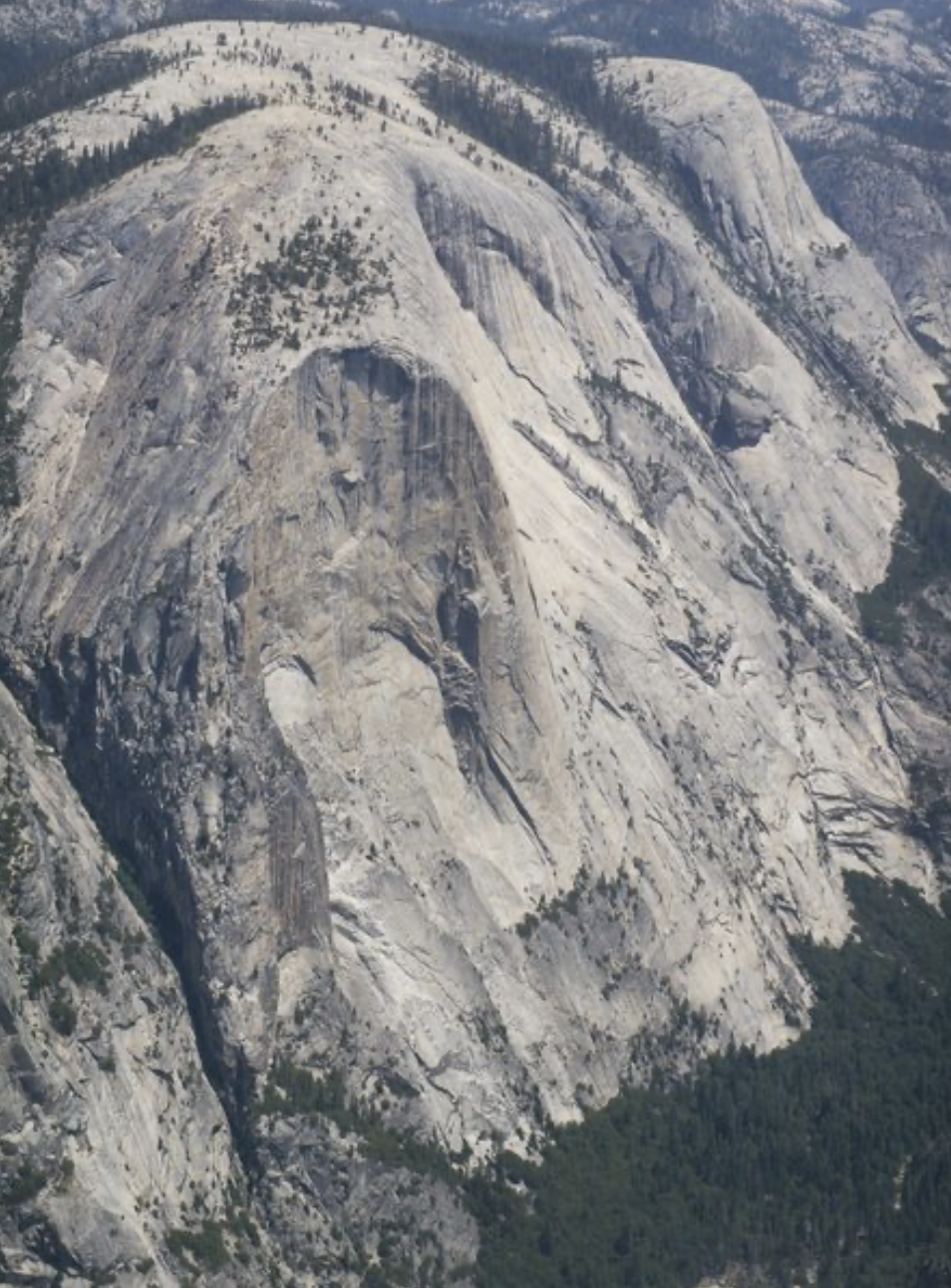
(Internet Image)
Mount Watkins, Yosemite Valley, California. The South Face route goes directly up that great center-face scoop of granite.

South Face of Mt. Watkins, Yosemite Valley, California
Big wall climbers Warren Harding, Chuck Pratt and Yvon Chouinard are attempting a "golden age" first ascent of a 2,200 foot, Grade V big wall in the mid-summer heat of Yosemite Valley. As recounted by Pratt:

"After only one day on the wall it was evident to all of us that our greatest difficulty would be neither the climbing, not the logistics, but the weather. It was middle of July and temperatures in the valley were consistently in the high nineties... we had allowed ourselves one and one-half quarts of water per day per person... still, we were not prepared for the intense, enervating heat in which we had found ourselves sweltering for an entire day."

"After nearly three days of climbing, the heat had reduced our strength and efficiency to the point of a snails pace... we were well aware of our critical situation. We had brought enough water for four days. It was now obvious that we could not reach the summit in less than five. 700 feet remained between us and the giant ceiling at the lip of the summit and the route remained uncertain. We reluctantly agreed that it would be necessary to reduce our ration of water to provide enough for at least one additional day on the face..."

"By the fourth day Yvon had lost so much weight from dehydration that he could lower his climbing knickers without undoing a single button. For the first time in seven years I was able to remove a ring from finger, and Harding, whose resemblance to the classical conception of Satan is legendary, took on an even more gaunt and sinister appearance... the fourth day proved to be one of the most difficult and uncertain any of us had ever spent on a climb... Warren had nearly fainted several times from the heat. Yvon was speechless with fatigue and I was curled up in a semi-stupor trying to utilize a small patch of shade beneath an overhanging boulder... that morning we had had two full quarts of water for the three of us. Yvon and I had already finished one quart and when he joined me I was surprised to find he still had a full quart. Warren had refused to take any water that day, preferring to give the climbing team every advantage. His sacrifice was a display of courage and discipline that I had rarely seen equaled."

"Yvon... tapped his way to the crest of Mount Watkins just as the sun went down. His triumphant shout told me what we had all waited five days to hear. Warren... asked to clean the last pitch as he felt that he had not contributed enough that day! Warren Harding, who had been the original inspiration for the climb, whose determination had gotten us over the headwall below and who had sacrificed his ration of water after five days of intense thirst felt that he had not done enough!"

'The South Face of Mount Watkins', Chuck Pratt
The American Alpine Journal (1965)
_______________

These two excerpts always come to mind along some low adventure when partners dramatize trivial incidents, e.g., wasp stings*, mis-step crossing a stream and their boot gets soaked, minor falls, scratches, contusions, abrasions, cuts (class I hemorrhage - short of stitches) and such, into tragedy of Shakespearean magnitude. And more often than not well-nigh a 1/4 mile or less bail back to the vehicle if necessary for them to "quit and go home".

The Mt. Watkins tale has forever been our gauge for physical endurance when considering "bagging it". Never even came close.

We always carry a quart of water per day, but have seldom ever drank more than a pint. Ever since store-bought bottled water became available years back, we just toss two of those in the pack. Almost always return with one full. Haven't carried a canteen or Nalgene bottle in many years. 

Had a buddy who tagged along with us once, forming a three man crew. Supposedly sporting a rough hangover, he drank our entire three quarts of water for the day before we were on the trail for 1/2 hour. A pretty hot day ta' boot. We stayed out a few hours extra just to punish 'em. He'd probably have gotten tossed off the side of the mountain if with those guys.

* The third guy (or gal) along the mule train is always the one who gets swarmed when accidentally disturbing an unseen ground wasp nest. Usually yellow jackets hereabouts. Happens every time. Always pretty comical unless it's you.

Sunday, February 2, 2025

Perfect Storm (A Brief Review of SWPA Ice Craft) Part II, aka: "Last of The Buffalos"

 "Few people are as passionate or as dedicated to rock, ice and mixed climbing 
as Tim Anderson... he continues to develop new areas and pioneer new routes
at existing crags... the climbing community is very fortunate to have such a strong
climber with such a powerful drive to develop modern routes for all of us to enjoy."
                                                
                                                            - Rob (Griz) Ginieczki, 'Ice Climbing Pennsylvania' (2006)

Quite of an accolade , and from the esteemed "Griz" himself. We'll add:

"If Tim ain't out climbin', or at least involved, ain't nothin' happenin'."

List of Modern Laurel Highlands Ice: 2002 - Present
Secret Cliffs II, Grade 4+ - 6
Secret Cliffs, Grade 4 -5
Confluence, Grade 4 - 5
Plus many, many new routes added to earlier era walls and flows along with introduction of mixed lines and dry tooling, that, knowing Tim and a few of his cohorts, probably grade up to the M10 level of difficulty.

Boy, until setting down to compile this information we had never really thought about it, but just to summarize for the sake of brevity, "That f*k'n Tim put up a lot of impressive sh*t!"

Cover art for a photo book that we began in 2010. Got a few pages into it but then abandoned the project. Never went back to finishing it.

Viewing southeast along the approximate 1,500LF expanse of Grade 4+ to Grade 6 continuous, steep, vertical ice forming the Secret Cliffs II. The northeast striking wall return off in the distance offers very difficult mixed climbing potential.

Lean conditions viewing along the central and right walls.

The awe-inspiring 'Beast Wall'

Viewing up the Grade 6 'Beast' ("Griz" Ginieczki climbing) - we're gonna' go on record to comment that, "This is the largest concentration of hard single-pitch ice routes in the eastern USA"; a bit of paraphrased homage to Vermont's Lake Willoughby's claim to the "hardest multi-pitch" moniker.

Two video clip screenshot extractions - Tim on the imposing, free hanging 'Sick-le'

The 'Beast Wall' in lean conditions (Dr. Bob Coblenz climbing)

'Central-Right Wall' in big conditions (Laura Anderson climbing)

'Beast Wall' in thin, mixed conditions (Tim climbing)

Climbers adding scale to the 'Beast Wall' (Tom Kopler foreground)

An airy spot high on the 'Beast' in good conditions (Tim climbing)

Two new, seldom formed routes at the 'Gun Club' (top: Tim climbing; bottom unidentified)

Video clip extractions - mixed dry tooling at the Meadow Run Amphitheater, Ohiopyle SP (Tim climbing)

Meadow Run Amphitheater (Laura Anderson climbing)

Our loyal scribe at Buzzard (Krahlak) Falls in superb, fat, plastic blue ice conditions - need a thousand feet of this stuff!

A fat 'Irishtown/Mouth of Madness' (Tim Climbing)

Video clip extraction - mixed 'Gun Club/Internet Connection' (Tim climbing)

(Tim Anderson Images)
Always the innovator - Tim and Laura on some SWPA alpine they found
Looks high, windy and cold... we wanna' go!

Overlooking the vast Allegheny Plateau from high in PA's "Twilight Zone"

We came across this old Geologic Map of Fayette County years back. It was annotated with all the old, mostly abandoned mines and quarries of record. We highlighted the mine/quarry markers in blue for clarity. We further annotated the marker bed Loyalhanna Limestone crop lines in red. The Loyalhanna Limestone mines are usually location of steep ice flows as well as karst cave formation. An added bonus - the Mauch Chunk sandstone formation sits directly atop the limestone. The Mauch Chunk formation where exposed, be it walls or breakdown boulders, forms the majority of climbable rock in the Highlands. We further annotated the map with a few locations of the climbing areas discussed herein for ease of navigating the map features..... you're welcome.

Finally, more unexplained phenomena from SWPA's "Goblin Universe" - the odd and mysterious "Wild Climbing Man". Those who have encountered this strange being claim that he leaps from the forest from nearby rock outcrops without warning, usually naked, and in a high pitch screeches "Hey mister - you wanna' climb with me!?" He then swiftly scampers spider-like up the rock face and disappears. Prior to each encounter witnesses claim to an odor similar to "burning fiber rope or burning dry grass and hay", some say "ganja", minutes before his appearance. 
Outer space alien? Inter-dimensional being? Inner earth denizen? Or hoax? You be the judge!

And lastly, we'll speak for all....
Thanks Tim!!

Saturday, February 1, 2025

Perfect Storm (A Brief Review of SWPA Ice Craft) Part I

                  "Sports are just like most other human activities. They go through times that, when
                    we look back on them, seem to have been usually lively or dynamic, just as they
                                      go through times when it seems little is happening."   
                                                                               - 'The Bear Hunters Century' (Paul Scullery, 1988) 

... to which we add "especially if the sport is as singularly dependent to optimal weather conditions as climbing frozen waterfalls,"

Been quite a few years since we've experienced cooperative weather conditions conducive to the efforts of a few local folks pursuit of the fun of more often than not enduring near frozen fingers and toes and occasional self inflicted fear and dread while dangling high above implacably hard ground secured to a hulking, unpredictable sheer wall of ice by nothing more than the tempered steel points of two potentially body piercing pickaxe and a few foot spikes, themselves potentially limb breaking, body flipping (or both) in the event of a fall; the ice protection is sparse, spread out and unpredictable; the golden rule of ascent being "the lead climber must not fall!"

Maybe ten years.

So, ventured out to the 'Gun Club Wall' a few days back to check out the current ice conditions. Temperatures hereabouts have not breached the high 20's (Fº) as yet this new year, piquing curiosity. Still, didn't expect much considering the "flash freeze" and dry, near desiccated ground consequential to consecutive months of drought weather pattern and low relative humidity.

The extended dry period prompted this mid-summer warning posted to the club's facebook page

Gun Club, 24Jan25 (or, 24 days -32ºF)
Our expectations were somewhat correct. The main flow not lookin' bad, with an added opportunity about for a mixed line or two. Using this as a visual measure augmented with past experience, we're bettin' that proximal walls with sufficient channel flow; e.g., Layton Falls, Buzzard (Krahlak) Falls, were maybe "in"; possibly "fat". This also considers ice buildup we've observed along the waterfall of a local nearby creek as well.

Gun Club Wall 2014, when it all comes together. 
Alternating cycles of freeze/thaw (cold nights/moderate days), sufficient seeping groundwater, adequate snow precipitation, moderate relative humidity.

Gun Club Wall early 2000's
Then if lucky ya' get the super elevated conditions (abundant precipitation and groundwater, cycling freeze/thaw, moderate to high humidity). Maybe once every fifty years. We'd been climbing there for around twenty years prior to that season. If we'd have had no knowledge, or had not been there ourselves, and ya' sprung this image on us, we'd have had no idea where this was.

Used ta' be that touching upon the notion of climbing ice, or "mountain climbing" in general, within the Laurel Highlands region, and specifically the 'Chestnut Ridge' of SWPA, was looked upon the same as if ya' mentioned encounters such as Bigfoot, UFO's, Thunderbirds and such phenomena frequently reported, always unsubstantiated, throughout the forests of the "Pennsylvania Twilight Zone"... "Ya' need to go out west to Colorado for that stuff!" was always the comment, even from seasoned climbers that we knew. 

Well, we knew that stuff was out there - and some pretty spectacular 'ta boot (through the help of a few bygone quarry operations). We'd seen it. And had photographic evidence...

Early encounters, '80's - '90's:

(For historical purposes, note that blue highlights, i.e. '00, indicate first year that we, or others we know of, have climbed on these frozen formations.)

Layton Falls '82 - a large portion of the upper falls collapsed, precipitated by that large pothole, shortly after taking this photo - and after having been ascended a few times this day. Just missing us. Our introduction to ice climbing.

Layton Falls late 80's. 

Meadow Run, Ohiopyle SP '82 - some now archaic gear. High tech at the time.

Buzzard (Krahlak) Ice Falls '84

Buzzard Ice Falls early '90's. Standard rack for the (Grade IV) vertical stuff pictured herein. A few Black Diamond SS chromoly screws and quickdraw runners pictured.  All these areas are pretty short lengthwise; <80ft. Heck of an improvement over the earlier (Type 4340?) steel Chouinard screws, along with a couple cheap Russian titanium screws we owned. And you could set and place 'em with one hand. The crux of the climbing using the old steel screws, commonly more so than the actual climbing itself, was hanging and getting the screws to bite, needing both hands free, then cranking them into the ice. 

We seldom placed more than 2-3 screws. Other than the pump factor, vertical, thick, plastic ice seldom feels (at the easiest) more difficult than 5.8 rock climbing. Usually liked to get a screw near the top, though. Steep top outs with tools and crampons always felt two grades harder and quite often scary when the ice doesn't form all the way or falls short of the face, with the top frozen turf or rock.
Still wish that we had that now vintage 'NFL Films' cap. Was given to us by a retired NFL films cinematographer we had come to know. He'd worked most of the 60's and '70's NFL seasons and was full of tales. Flipped a river boat once and lost it. 

Meadow Run. Testing out a budget tool set. 'Sabres' we think they were called, manufactured by Forrest Mountaineering. Bought 'em as a spare set for use whenever we could coerce a non-ice climbing friend along. More ice routes than climbers back then. Not their 'Lifetime' brand tools. Fixed hammer/adze heads (although, recall a roller pin fastener - never saw replacement heads in their catalog, though). If ya' broke 'em they were done. Unless swung dead on they skipped, bounced and vibrated like crazy. Scary stuff - don't flame out with these in hand. Their lifetime tools and Mjollnir hammer were ok, though. Still, all that stuff was susceptible to breaking. First time we observed "modern" dry tooling which involved liebacking and torquing pick tips in thin cracks, successfully without breaking of coarse, we were bitin' our nails. We'd broken earlier picks just levering them, overdriven, out of plastic ice. Breaking a pick was our biggest dread if on lead. Never passed up an opportunity to hook a tool. No excuses, though -  a crusty, old time '50's-'60's era river runner once harrumphed, while lookin' over our flashy new Dagger WW canoe "Hey - if you can really paddle you can navigate a ten foot wood 2x12 down the river!". We still believe 'em.

'Sliding Board' at 'Victoria Flats Ice Falls', Ohiopyle SP '87.
There's a few pretty good Grade 2/2+ gullies flanking the Yough River gorge. Over 200ft length and a bit of a wilderness experience. Used to be able to drive to the base of 'em before the Yough River Bike Trail was built.

Ice "bouldering" along the upper wall at 'Irishtown' '84.

Ice bouldering the small flows along the old 'P&LE' mine on a warm day, '84

Although dated much later, we're including these two images as they illustrate optimum conditions. Both areas were climbed back in the '80's.
Top: 'Irishtown' and 'Mouth of Madness' '84 (photo: early 2000's)
Bottom: 'Rod and Gun Club' '84 (photo: early 2000's)

List of significant Laurel Highlands ice, 1980 - 2000
Rod and Gun Club, Grades III - IV
Irishtown, Grades III - IV
Buzzard (Krahlak) Falls, Grade IV
Layton Falls, Grade III - IV
Meadow Run, Grade III - IV
Darlington Quarry, Grade III - IV
Victoria Flats, Grade 2 - 2+
P&LE Mine, Ice Bouldering

We'd hung up the tools at the beginning of the current millennia. Shortly thereafter we became acquainted with a highly motivated and (as ourself) wonderfully irreverent fellow named Tim Anderson. Quite a bit younger, Tim was out lookin' to climb everything. At the time climbing in general was experiencing a bit of an overall transformation: popularity, ethics and gear innovation. Tim was on top of it all. We acquainted 'em with a few areas he wasn't aware of as to unburden 'em with much of the search and error that we experienced throughout the earlier years. Photography was goin' thru a bit of overall transformation as well: conversion as an overall digital medium including simplistic video editing systems. After little consideration, we figured "Well, we'll stick by for a few more years to follow this guy around to see what he's up to. An opportunity to experiment with some digital photography as well -  Sounds like fun!"... more on that in Part II...

'Stinky', lookin' a bit haggard after a long day